
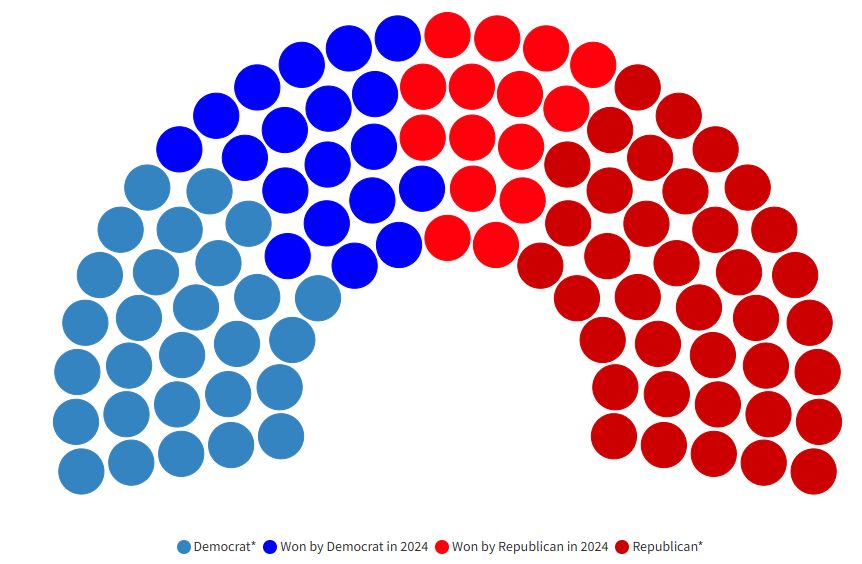
Current Senate seats composition, 2024: Democrats: 47 | Republicans: 53
As of mid-June 2026, my prediction is that Republicans will end up with 51–53 Senate seats, with 52 seats being the single most likely outcome.
Current situation
Republicans currently hold a 53–47 majority in the Senate. Democrats would need to gain four seats (or three plus the vice presidency in a tied Senate) to take control.
Forecast
| Outcome | Probability |
|---|---|
| Republicans 54+ seats | 15% |
| Republicans 53 seats | 25% |
| Republicans 52 seats | 35% |
| Republicans 51 seats | 15% |
| Democrats win Senate (50 or fewer GOP seats) | 10% |
Why I expect Republicans to lose a seat or two
Several Republican-held seats are highly competitive:
- North Carolina is arguably Democrats’ best pickup opportunity, with former governor Roy Cooper running in an open-seat race. Many forecasters now rate it among the closest contests.
- Ohio has become much more competitive than Republicans expected.
- Alaska is a legitimate battleground because of former Representative Mary Peltola’s crossover appeal.
- Maine remains competitive due to Senator Susan Collins facing another difficult reelection race.
Why Republicans are still favored
Democrats also have difficult defenses:
- Michigan is an open Democratic seat and remains highly competitive.
- Georgia is never an easy hold for Democrats in a midterm environment.
- Democrats must win nearly all major toss-ups while protecting their own vulnerable seats. Most election analysts still view Republicans as favorites to retain control.
Specific prediction
My state-by-state expectation today:
- Democrats flip North Carolina.
- Republicans hold Ohio, Alaska, and Maine by narrow margins.
- Democrats hold Michigan and Georgia.
That would produce a 52 Republican – 48 Democratic/Independent Senate in January 2027.
If the national political environment shifts further against President Trump during the summer and fall, the most likely alternative becomes a 51–49 Republican Senate. Conversely, if Republicans recover in the battleground states, they could remain at 53 seats.